
National Digital School Plan and Stakeholders.
The National Digital School Plan (PNSD) turns two, since its launch on October 27, 2015. Bologna and schools across Italy celebrate the National Digital School Plan Festival from January 18-20, 2018 – #FestaPNSD. With the aim of renewing and digitalizing Italian schools, the PNSD calls for implementing new digital technologies in courses of study, supported by new teaching paths and pedagogical plans, aiming to develop students’ skills rather than simply “transmitting” curricula, to activate cognitive processes, promote relational dynamics and build awareness. The working paradigm is skills-based teaching, understood as design centered on cross-curricular work, sharing and co-creation, and as teaching characterized by exploration, experience, reflection, self-assessment, monitoring and evaluation.
PNSD Phase 1 – 2009-2013 Goals, Actions and Results
Interactive Whiteboard in the Classroom Action (2008) – IWB rollout, equipment increase, spreading training on new teaching technologies: teacher training for classes involved in the IWB action, on classroom use of the tool and building learning paths using ICT (90,000 teachers trained); support for teaching design offered to Class 2.0 teachers. Results: 35,000 IWBs, 416 Class 2.0s, 20 Digital School Publishing Schools, 14 Schools 2.0.
Class 2.0 (2008) – spreading technology in daily school activity to develop and stimulate digital skills among teachers and students.
Digital School Publishing Action (2010) – surfacing innovative proposals and solutions giving schools the chance to try new digital learning products, suited to the cognitive styles of digital natives and to learning environments, open to online resources, with various services genuinely fit for the Italian school cultural context.
Patto Scuol@ 2.0 (2011) – Digital School Centers – equipping schools with technology and IT solutions.
PNSD Phase 2 – 2013-2014 Goals, Actions and Results
Infrastructure and equipment consolidation and increase strategy: 1. Reshape the training plan; 2. Adapt actions to training needs; 3. Geolocate and re-systematize; 4. Leverage existing resources; 5. Schools 2.0 community.
MIUR-Region agreement data: 1,931 IWBs, 905 Class 2.0s, 21 Schools 2.0, 45 Digital School Centers, 679 Lombard schools (Web Generation Project).
PNSD Phase 3 and Stakeholders Club – with SmartMedia’s participation
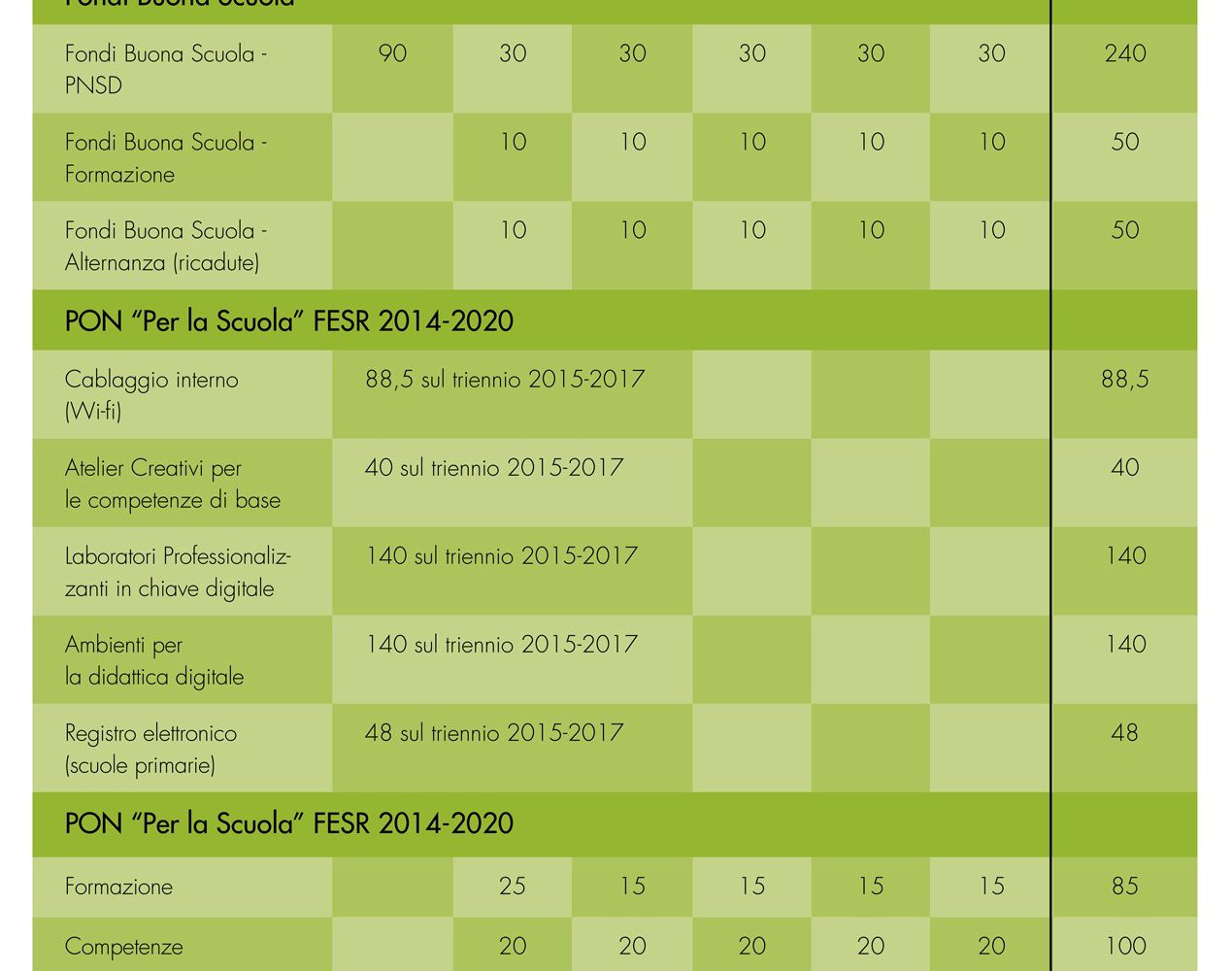
PNSD Phase 3 comprises 35 actions funded by European Social Fund resources (PON Education 2014-2020) and Law 107/2015 funds. Among the National Digital School Plan’s goals is establishing the Stakeholders Club for the Digital School, a permanent partnership of companies, players and innovation communities, helping schools sustain change and innovation and build forward-looking educational responses. SmartMedia s.r.l. was chosen by the Ministry of Education as a partner to promote a culture of innovation and modernization of the school system through awareness and training projects on the use of new technologies in schools, including for lab-based teaching. To this end, SmartMedia and MIUR signed a three-year Memorandum of Understanding, through which SmartMedia commits to providing an appropriate number of classes with its SmartMedia Pro teaching network software, letting students and teachers interact collaboratively, including through group work management.
PNSD Phase 3 – 2015-2020 Goals
The 35 PNSD Actions cover: Access (Fiber, Cabling, Connectivity fees); Learning Spaces and Environments (integrated digital teaching spaces, digital school challenge prizes, BYOD, lab plan, innovative school building synergies); Digital Identity for every Student and Teacher; Digital Administration (administrative digitalization, electronic register, “school data” strategies); Student Skills (a common framework for student digital skills, innovative scenarios for applied digital skill development, a 21st-century skills research unit, bringing computational thinking to primary school, updating the technology curriculum in lower secondary school); Digital, Entrepreneurship and Work (a digital entrepreneurship curriculum, Girls in Tech & Science, a Digital Careers Plan, school-to-work programs for digital business); Digital Content (minimum standards and interoperability for online learning environments, promoting Open Educational Resources and guidelines on self-produced teaching content, school libraries as digital-literacy environments); Staff Training (in-service training for teaching and organizational innovation, technical support for first-cycle schools, strengthening initial training on teaching innovation, new training for newly hired staff); Support (a digital animator in every school, local agreements, the Stakeholders’ Club for the digital school, a gallery of practices, ongoing listening for innovative networks, a Digital School Observatory, a scientific committee to align the Plan with international practices, monitoring the entire Plan, the three-year training-offer plan).
Contact SmartMedia
Call us now: Tel. 06 85301860 email: informazioni@smartmediaworld.net www.smartmediaworld.net